

Your Ad Spend Should Not Be a Mystery

Kirsten Johnson, Founder of Reverie
Digital ads can be powerful.
They can help the right people find your business, call your team, book a service, request a quote, or take the next step toward working with you.
But ads can also become one of the easiest places to waste money if there is not a clear feedback loop.
Some estimates place wasted digital ad spend somewhere between $60 and $100 billion per year. That number is staggering, but it makes sense when you think about how many businesses are running ads without truly knowing what is working, what is not working, and whether their budget is actually producing leads.
At Reverie, we believe your ad spend should never feel like a mystery.
More Ads Are Not Always the Answer
It is easy to assume that the solution to better marketing is simply more.
More ads.
More variations.
More campaigns.
More budget.
But more activity does not always mean better results.
One of the strongest reminders we have heard around this topic is the idea that constantly creating new ad variations every month without learning from what is working and what is not working can waste thousands, if not millions, of dollars.
That is the part too many businesses miss.
The goal is not just to run ads. The goal is to learn from them.
If your campaigns are producing clicks but not calls, that tells us something. If one campaign is bringing in leads at a reasonable cost and another is draining budget without meaningful results, that tells us something too.
The data should guide the decisions.
What Accountable Ad Spend Looks Like
When ads are tracked properly, we can move beyond guessing.
Instead of asking, “Are the ads working?” we can start looking at real numbers that tell a clearer story.
For example, one Google Ads account we reviewed showed:
• 467 total conversions
• $33.45 average cost per conversion
• 24.25% conversion rate
• 367 phone calls
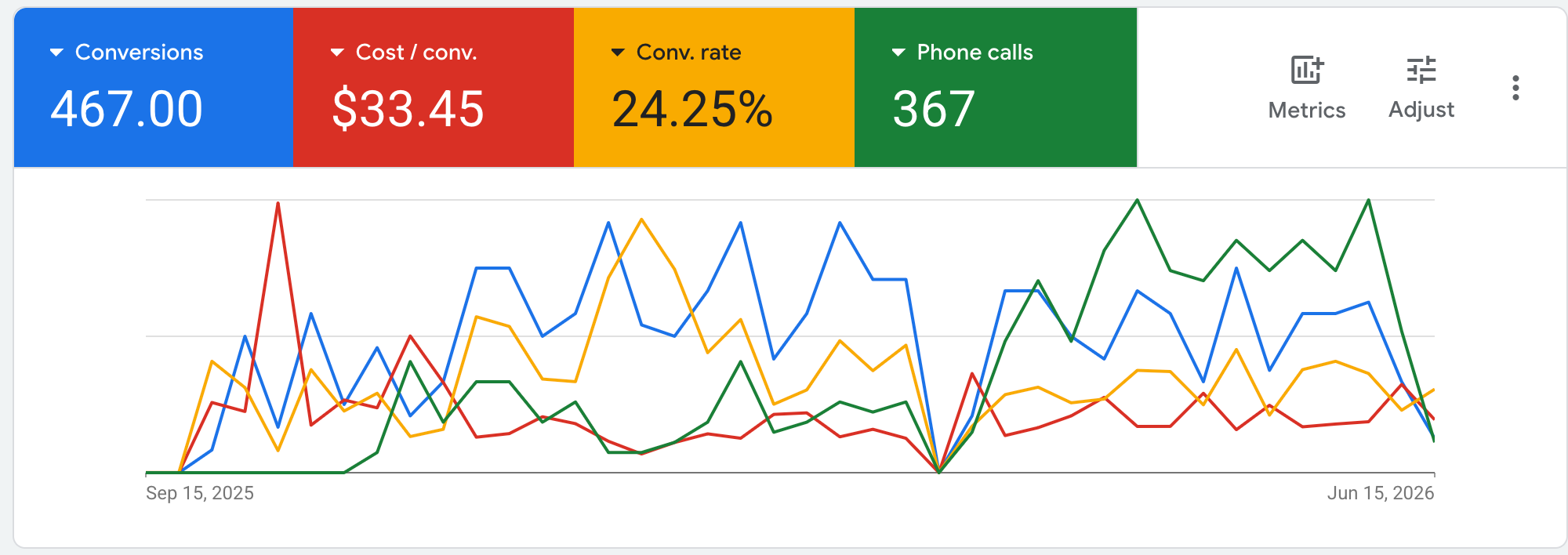
Real Google Ads campaign data showing how ad spend tracking helps measure conversions, cost per lead, conversion rate, and phone calls from digital advertising.
That kind of data matters because it gives us something tangible to evaluate.
It helps us understand whether people are taking action. It shows us what types of conversions are happening. It helps us see whether the campaign is generating real lead activity, not just traffic.
And just as importantly, it helps us know what needs to be adjusted.
Clicks Are Not the Same as Leads
A campaign can get clicks and still underperform.
That is why we do not want to stop at surface-level reporting.
Clicks can tell us that people are interested enough to visit. But calls, form submissions, booked appointments, and conversion actions tell us whether those clicks are turning into something useful for the business.
This is where tracking becomes so important.
If a business is spending money on ads, it should be able to see where that money is going and what it is producing. Without that visibility, it becomes very difficult to make confident marketing decisions.
You might keep funding a campaign that is not converting.
You might pause something that was actually working.
You might spend more without understanding where the real opportunity is.
That is how ad spend becomes wasteful.
Real Data Helps Us Make Better Marketing Decisions
Good marketing is not about guessing harder.
It is about paying attention.
When we have clean campaign data, we can ask better questions:
• Which ads are leading to phone calls?
• Which keywords are producing the strongest leads?
• Which campaigns are spending without converting?
• Which services or offers are getting the most traction?
• Where does the landing page need to be clearer?
• Is the budget being used in the right place?
This is where ads become more strategic.
Instead of throwing money into a campaign and hoping it works, we can make thoughtful adjustments based on what the data is showing us.
Sometimes that means refining keywords.
Sometimes it means improving the landing page.
Sometimes it means changing the call to action.
Sometimes it means shifting budget toward what is already producing better results.
The point is not perfection. The point is accountability.
Your Marketing Budget Deserves Clarity
For many small businesses, ad spend is not casual money.
It is real money. It is budget that could be going toward payroll, equipment, operations, hiring, or growth.
That is why we care so much about making sure the money being spent has a clear purpose.
You should not have to wonder whether your ads are producing leads.
You should not have to rely on vague reports or vanity metrics.
You should be able to understand what is happening, what is being improved, and how your marketing is supporting your business goals.
Because when ad spend is tracked well, it becomes more than a monthly expense.
It becomes information.
And that information helps us make better, wiser, more strategic decisions.
The Bottom Line
Your ad spend should not be a mystery.
More ads do not help if you are not learning from the data.
Real tracking helps us understand what is working, what needs to change, and whether your marketing dollars are actually helping people find and choose your business.
At Reverie, we believe marketing should feel clear, thoughtful, and grounded in what is actually happening.
Because when you can see the data clearly, you can spend with more confidence.
Ready to Make Sense of Your Ad Spend?
If you are running ads but are not sure what they are really producing, we would love to help you take a closer look.
Let’s review the data, identify what is working, and make sure your marketing dollars are being used with purpose.